When someone looks at a boat moored in a marina, they usually see two things: leisure and luxury. It is the most common reading and also the most incomplete. Behind that hull lies a supply chain involving heavy industry, fine joinery, onboard electronics, resin chemistry, naval engineering, logistics, tourism and specialised services.
This is the argument ACATMAR, the Brazilian Nautical Association, has been making for years: the marine sector is not a luxury good, it is an economic chain that generates jobs, income, tourism and development. And the best way to prove it is with numbers.
We have gathered here, in one place, the most current data on the sector, drawn from the Brazilian Navy, the Santa Catarina state government, IBGE, universities and ACATMAR itself. It is reference material, made to be used by those who need to defend the sector with data in hand.
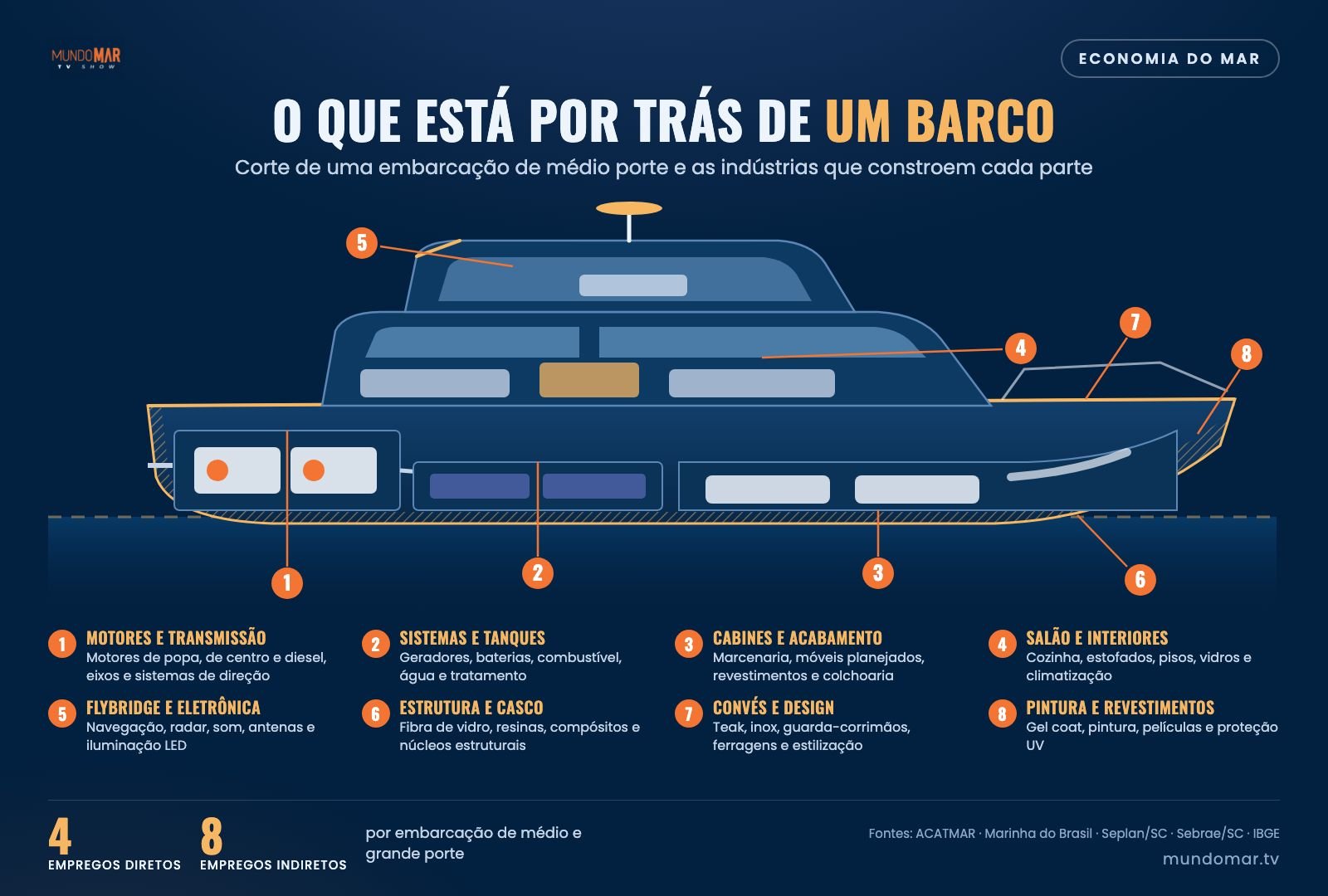
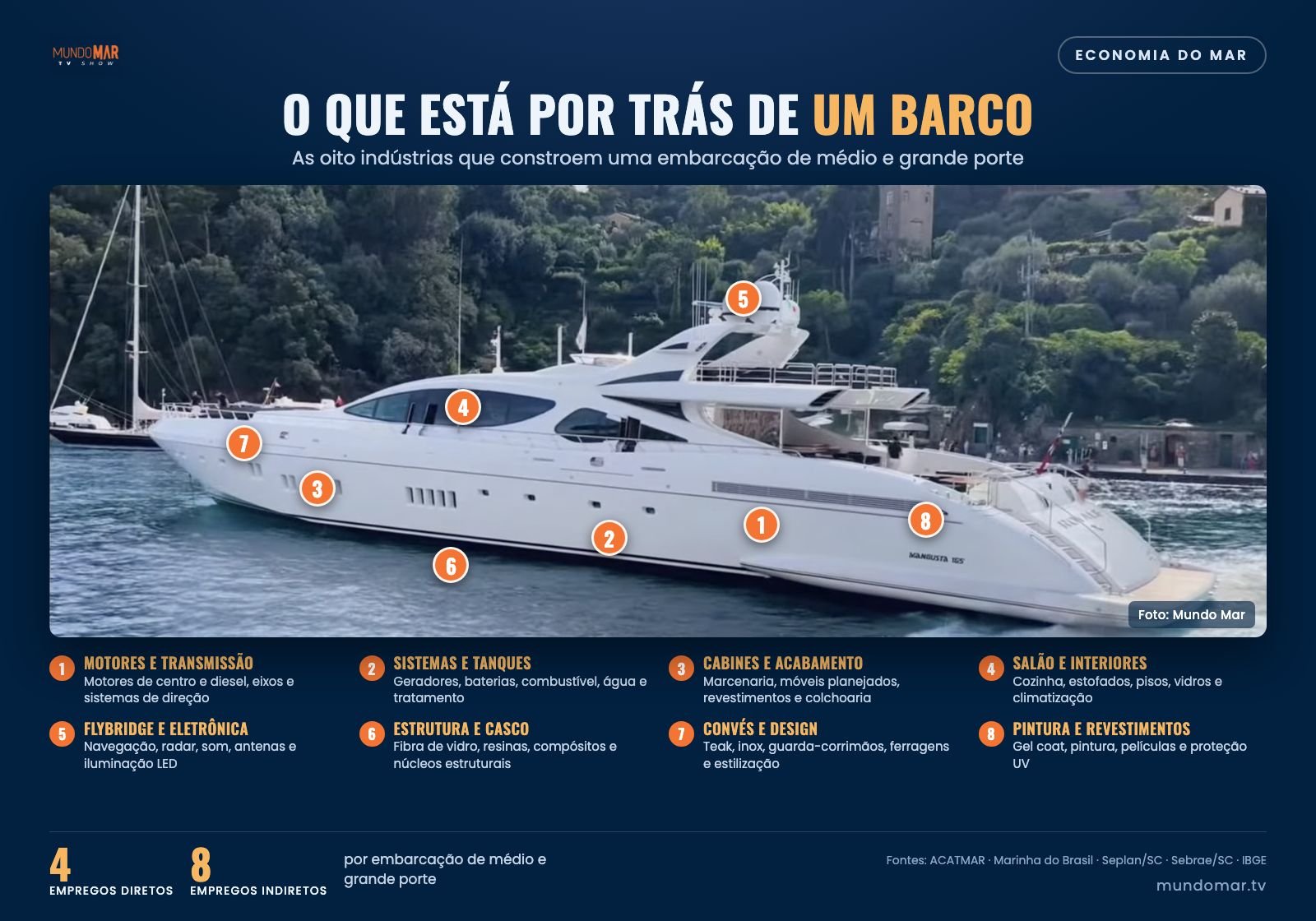
A boat is not a product, it is an assembly of seven industries
Building a medium or large vessel means bringing together, under the same roof, suppliers from sectors that are rarely associated with yachting. Here is what goes into each hull:
- Structure and hull: fibreglass, resins, composites and structural cores
- Engines and transmission: outboard, inboard and diesel engines, plus steering systems
- Interior finishing: fitted furniture, linings, galleys, floors and joinery details
- Deck and design: teak, stainless steel, handrails, accessories and styling
- Electrical and electronic systems: navigation, audio, generators, batteries and LED lighting
- Comfort and leisure: air conditioning, climate control, refrigeration and entertainment
- Paint and coatings: gel coat, paint, films and UV protection
Note that this includes chemical, metalworking, furniture, electronics and textile industries. A shipyard is, in practice, an integrator of supply chains.
How many jobs a boat generates
This is the figure that best translates the sector's impact, and it comes from ACATMAR:
Every medium and large vessel generates, on average, 4 direct jobs and 8 indirect jobs.
That is, for every job inside the shipyard, two more open up outside it: at the stainless steel supplier, at the joinery, at the marine electronics store, in transport, at the marina that will host that boat and in the service that will maintain it for the next twenty years.
Santa Catarina, the heart of Brazil's marine industry
No state translates this chain better than Santa Catarina.
- 68% of Brazil's leisure boat exports come from Santa Catarina
- 1,028 companies make up the Ocean Economy in the state
- 50,000 recreational vessels are registered in Santa Catarina
This leadership was no accident. It results from the combination of entrepreneurship, public policy and the formation of a highly specialised supply chain. One milestone was the creation of the Marine Industry Incentive Programme in 2009, which encouraged companies to set up and consolidated the industrial hubs of Greater Florianópolis and the Itajaí Valley. The same year saw the birth of the Naval Engineering course at UFSC, created precisely to serve the sector's expansion in the state.
When a hub forms, it pulls the rest along. Around the shipyards came stainless steel, mechanical, electronics and transport companies and other suppliers, and the chain also reached retail, services and nautical tourism.
Santa Catarina's ocean economy in numbers
Here the data comes from Seplan, the Santa Catarina State Planning Secretariat, based on the Novo Caged register. It shows the size of the ocean economy beyond the marine industry:
- 250,000 professionals work in Ocean Economy activities in Santa Catarina
- That represents 8.5% of the entire formal workforce of the state
- Between March 2025 and February 2026, the sector opened around 6,000 new formal positions, the equivalent of 13% of the state's entire job creation balance
- In February 2026 alone there were 1,929 new contracts, or 11% of the national total for these activities
- The segments contributing most were warehousing, engineering services and hotels, together accounting for more than 35% of the balance
And Santa Catarina's ocean economy goes beyond boats:
- The state concentrates 61% of Brazil's fishing industry, which moves R$ 3.8 billion a year and accounts for 20.9% of national jobs in the chain
- It leads national production of oysters and scallops, with 2,481 tonnes
- It ranks 5th in aquaculture production value, with R$ 543.7 million
- And it is the 4th largest tilapia producer in the country, with 47,112 tonnes recorded in 2025
Brazil from above: the national fleet
Fleet data comes from the Brazilian Navy, the body responsible for registering vessels in the country:
- 1.14 million vessels were actively registered between 1995 and 2025
- The 8th Naval District, covering Paraná, São Paulo and southern Minas Gerais, concentrates 427,000 vessels, or 37% of the entire national fleet
- São Paulo alone has 240,981 registered vessels, around 24% of the country's total
In other words: production is concentrated in the South, and consumption in the Southeast. This geography explains much of the sector's logistics.
Nautical tourism enters the equation
A moored boat generates no economy. What turns a fleet into income is use, and that is where nautical tourism comes in.
São Paulo has put a number on it. The São Paulo state government's Nautical Tourism Programme aims to raise the sector's turnover from R$ 6.3 billion to R$ 21 billion by 2033, with 60 public navigation support structures planned in the same period.
The market is responding. At the 2025 edition of the São Paulo Boat Show, 750 vessels were sold, up 7.1% on the 700 of the previous year, with 120 brands, 170 boats on display and 40,000 visitors.
The figure still missing: the Ocean GDP
Despite all this data, Brazil still has no official measure of the ocean economy's weight in GDP. That is changing.
A technical group coordinated by the National Planning Secretariat of the Ministry of Planning and Budget, in partnership with the National Accounts Coordination of IBGE, has completed the Methodology for Measuring the Ocean Economy in Brazil, approved by the Interministerial Commission for Marine Resources in October 2025. The next step is its application by IBGE and the release of the first results.
When that figure arrives, the sector stops relying on estimates and gains official statistics. It is the difference between arguing and proving.
The challenges on the table
Tax reform. The tax transition may raise the burden on the sector, and the qualification window for the compensation fund closes in December 2028. It is the industry's most urgent issue today.
The shortage of qualified labour. The sector is growing faster than it can train people. There is a shortage of professionals in lamination, mechanics, electrical work, joinery and marina operations. ACATMAR maintains training programmes and a partnership with IFSC in setting up the Escola do Mar, precisely to tackle this bottleneck.
The technological transition. The industry's major transformations run through the decarbonisation and automation of vessels. Hybrid engines, low-emission fuels, electrification and the advance of autonomous vessels are already on the radar, and Santa Catarina takes part in this research.
What the numbers say, in the end
Add it all up: 1.14 million vessels registered in the country, 250,000 people employed in Santa Catarina's ocean economy alone, 1,028 companies in a single state, R$ 6.3 billion moved by nautical tourism in São Paulo with a target to triple by 2033, and a chain of seven different industries behind every hull.
In ACATMAR's assessment, the growth potential is significant, and Santa Catarina's blue economy could advance around 10% a year, provided the state keeps investing in infrastructure, training and incentives for the sector.
None of this is luxury. It is industry, it is jobs, it is tax revenue and it is development. Next time someone says boats are a rich person's thing, show them the bill: twelve families live off every vessel that leaves the factory.
Sources
The data in this report was compiled from:
- ACATMAR, Brazilian Nautical Association: jobs generated per vessel, structure of the supply chain and growth projection for Santa Catarina's blue economy
- Brazilian Navy: registration and distribution of the national fleet
- Seplan, Santa Catarina State Planning Secretariat, based on Novo Caged: formal employment in the Ocean Economy, fishing and aquaculture
- IBGE and the Ministry of Planning and Budget: Ocean GDP methodology, approved by CIRM
- UFSC, Federal University of Santa Catarina: naval engineering training and the sector's technological trends
- Government of the State of São Paulo: Nautical Tourism Programme
- Santa Catarina marine sector data published by the specialised press
This report is updated as new official data is released. If you work in research, the press or public policy and need sector information, get in touch with us.
By: Redação Mundo Mar
Photo: Foto e infográfico: Mundo Mar