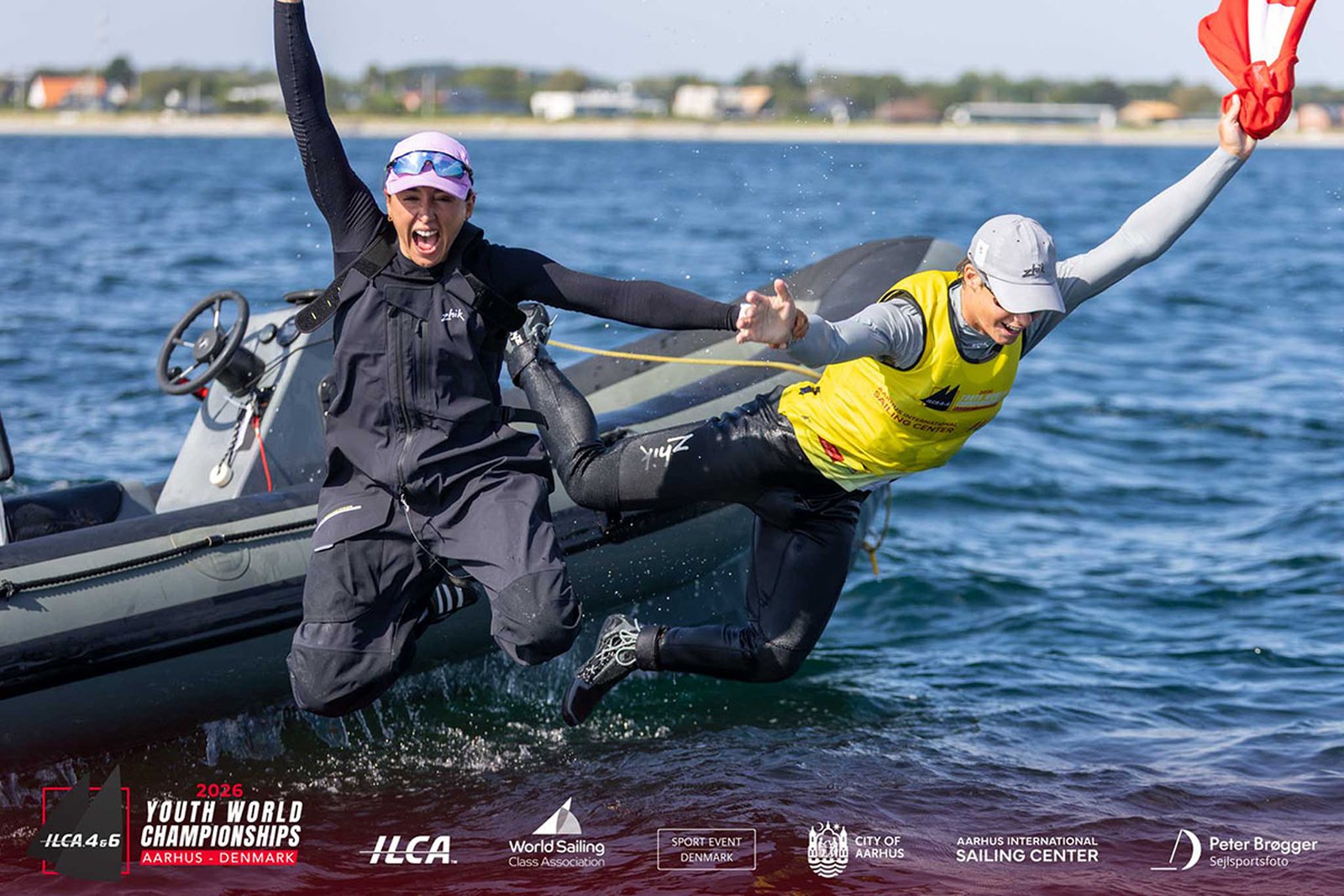
One of the championships that best translates the future of world sailing ended on Sunday in Aarhus Bay, Denmark. The ILCA 4 Youth World Championship brought together 448 sailors from 51 countries, a figure that gives the measure of the sport's reach and the strength of its base.
The titles went to Greece's Eleni Triantou, world champion in the girls' fleet, and Switzerland's Leo Gosling, champion in the boys' fleet. Two names that now join the list of young sailors emerging from this class.
The gateway to Olympic sailing
The ILCA 4 is the smallest of the versions of the boat known worldwide as the Laser, and it plays a very specific role: it is the way in for those who want to go far in sailing. The hull is the same as the larger versions, what changes is the sail, smaller and suited to the weight and strength of younger sailors.
This allows the athlete to grow within the class itself, later moving to the ILCA 6 and the ILCA 7, both Olympic. In practice, the ILCA 4 Youth Worlds is where you can see, today, who will most likely be racing for Olympic medals two cycles from now.
Why 51 countries matters
The number of nations represented is perhaps the most significant statistic of the championship. A class capable of bringing together 448 young sailors from 51 countries is a cheap, accessible class with stable rules, which is exactly the recipe for developing sailors at scale.
It is a lesson for any country that wants to develop sailing: broadening the base costs less and delivers more than investing only at the top of the pyramid. Without a strong entry class, there is no competitive squad afterwards.
The message for Brazil
Brazil has an Olympic tradition in sailing and a coastline few countries in the world possess. What the big youth world championships show, edition after edition, is that top-level results are born from a solid grassroots programme, with clubs, sailing schools and a calendar working together.
Aarhus, in the Denmark that became a world reference in sailing, is the example of how a city can organise itself around water sports and turn that into identity and into economy. The sea shapes people before it shapes champions, and that is where it all begins.
By: Redação Mundo Mar
Photo: Peter Brøgger / Divulgação ILCA