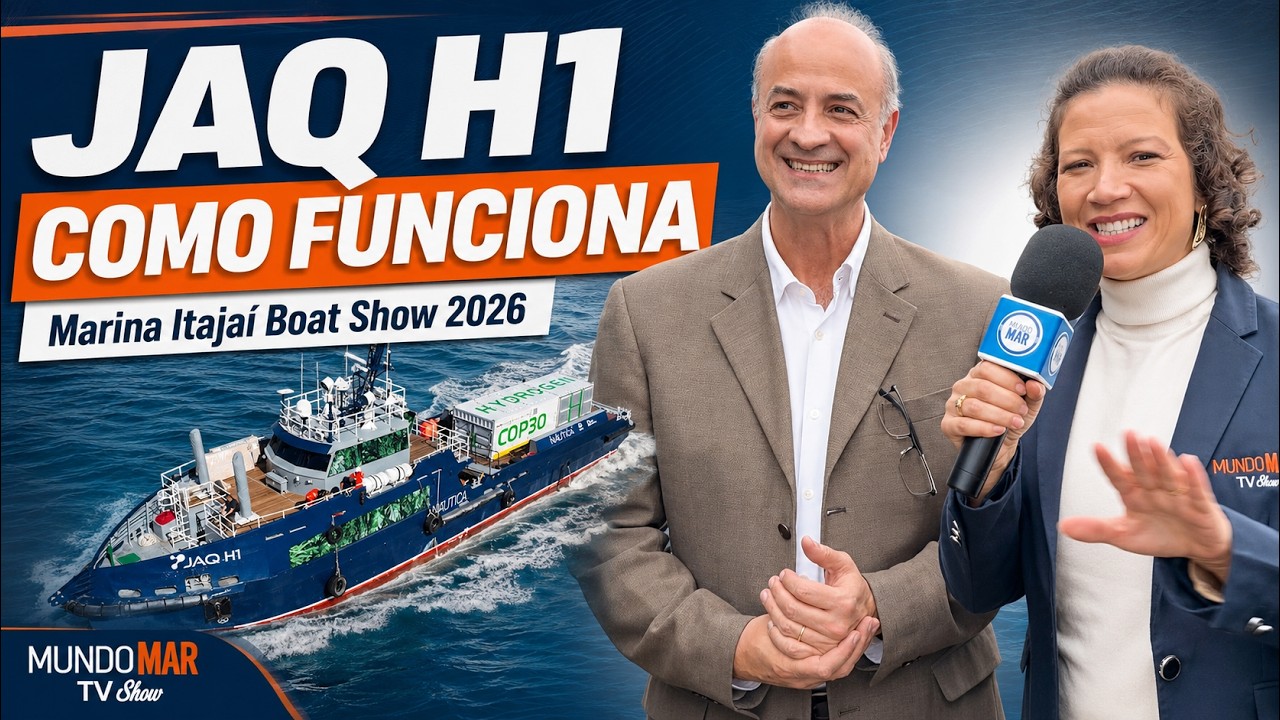
Rarely has Brazil been so far ahead when it comes to the future of navigation. The JAQ H1 is the world's first research and exploration vessel powered by green hydrogen — and it was born from an entirely Brazilian project, led by Grupo Náutica. Mundo Mar went on board during the Marina Itajaí Boat Show 2026 to show up close what this revolution represents.
A 36-metre floating laboratory
At 36 metres in length, the JAQ H1 was designed not only to sail, but to generate knowledge. The vessel works as a true floating laboratory, with space for scientific research and even classrooms on board — combining technology, environmental education and navigation.
The hull was built at the Inace shipyard in Fortaleza (CE), and the boat received a waterjet system, ideal for shallow waters. In practice, this allows the JAQ to navigate both the rivers of the Amazon and the Brazilian coast, with hybrid propulsion combining green hydrogen with high-efficiency MAN engines.
Why green hydrogen matters
Green hydrogen is produced from renewable sources, without emitting greenhouse gases when burned. Applied to boating, it points towards clean and quiet navigation, aligned with Brazil's energy transition goals.
More than a prototype, the JAQ carries a philosophy. In the words of Ernani Paciornik, president of Grupo Náutica and the project's creator: "We want to give back to the water what it has given us."
Showcase at COP30
It is no coincidence that the JAQ H1 was presented in Belém (PA), at Estação das Docas, on the eve of COP30 — the UN climate conference. The boat took on the role of sustainability ambassador for the event, showing the world a marine solution conceived in Brazil.
The project brings together major partners, including Itaipu Parquetec, the hydrogen division of GWM, MAN and the Brazilian Navy, in a rare example of coordination between industry, science and government around the Ocean Economy.
What comes next
The story does not stop at the H1. Grupo Náutica is already designing an even bolder successor: the JAQ H2, at 50 metres and with the promise of being 100% self-sufficient, expected for 2027.
For those following the marine sector, the message is clear: sustainability is no longer rhetoric — it has become hull, engine and route. And Brazil, once again, is showing that it knows how to sail ahead.
Watch our coverage on board
We went inside the JAQ H1 and showed, in practice, how this technology works. Watch the full programme and subscribe to our channel to follow everything that moves the marine world:
By: Redação Mundo Mar
Photo: Imagens Mundo Mar TV