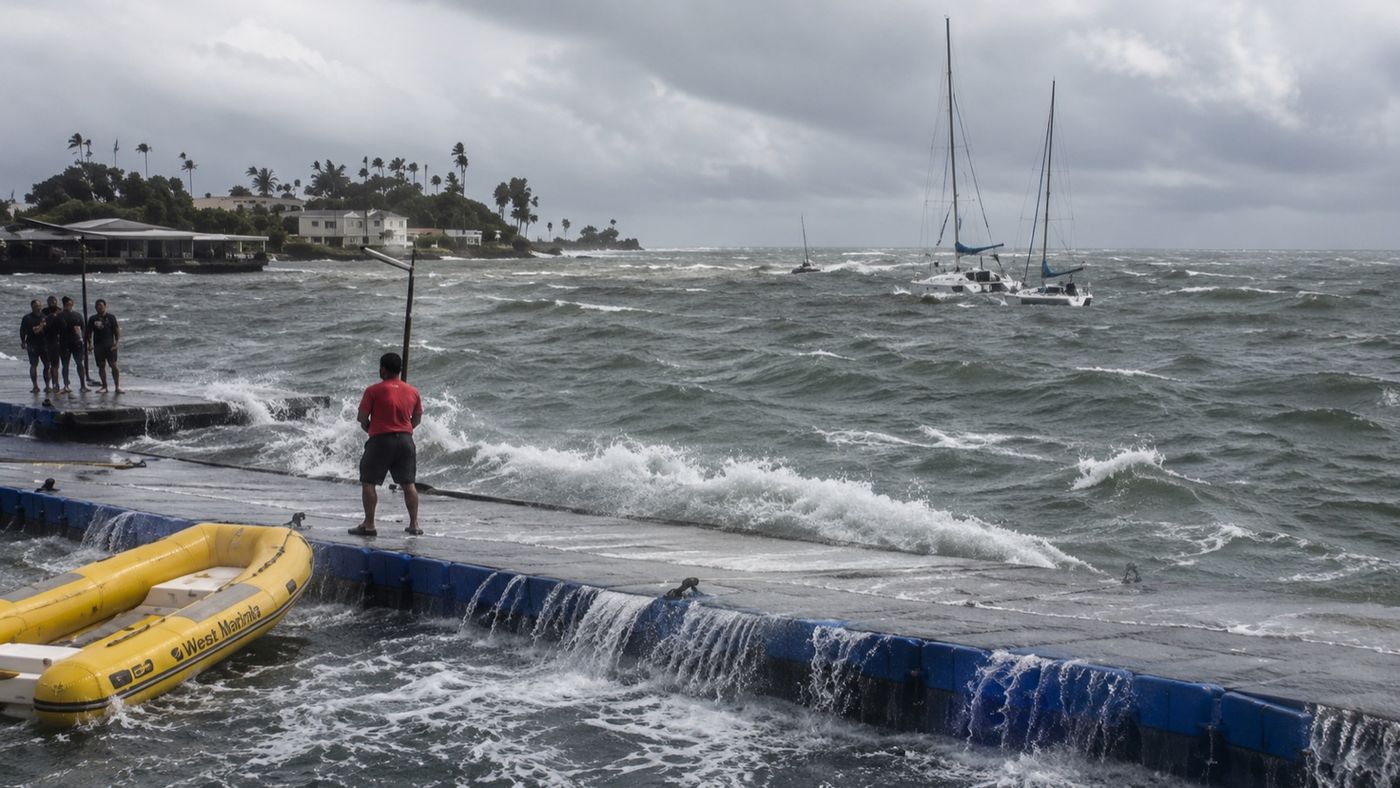
Wednesday, 29 July, will be remembered as one of the most challenging days of the 53rd Ilhabela International Sailing Week. The arrival of a cold front on the northern coast of São Paulo produced gusts close to 40 knots, approximately 75 km/h, forcing the organisers and the Race Committee to cancel the races scheduled for the day.
The decision was taken preventively, before the competitors were exposed to conditions incompatible with the safety of the fleet. Owners and skippers were also advised by the Yacht Club de Ilhabela, the YCI, to reinforce their mooring lines and adopt additional measures to protect their vessels.
Later, however, the intensity of the gusts caused incidents at different points of the municipality. According to the first official bulletin from the Ilhabela Civil Defence, the mooring blocks of some vessels anchored in the São Sebastião Channel broke. Without the hold of the mooring systems, the boats drifted and were carried by the wind and the currents towards beaches and hillsides of the island.
As of the closing of this article, the authorities had not released the number, the names or the extent of the damage suffered by the affected vessels.
An edition that gathered more than 120 boats
Held from 24 July to 1 August, the 53rd Ilhabela International Sailing Week brings together more than 120 vessels in the ORC, Bra-RGS, RGS-Cruiser, Classics, C30 and HPE25 classes.
In the traditional opening parade alone, held on Sunday, 26 July, 127 vessels sailed through the São Sebastião Channel, watched by thousands of residents and visitors. The 2026 edition also features names such as Robert Scheidt, Lars Grael, world champions, Pan American athletes, amateur sailors and crews from different regions of Brazil.
The size of the fleet makes any severe weather situation even more complex. These are boats of different sizes, displacements and mooring configurations, gathered in a region that, during the Sailing Week, receives a nautical movement far higher than usual.
The alert had already forecast winds between 71 and 90 km/h
On Tuesday, 28 July, the Ilhabela Civil Defence had already issued an alert for the passage of the cold front. The forecast pointed to gusts between 71 and 90 km/h on the northern coast of São Paulo, especially in the most exposed areas.
Residents, tourists and those responsible for vessels were advised to collect loose objects, avoid tree-lined areas and follow the official channels. The adverse conditions also increased the risk of rough seas, falling trees, and damage to roofs and vulnerable structures.
During the passage of the system, the Civil Defence confirmed fallen trees at different points of Ilhabela. Part of the roof of the Luna Fernandes Silva Municipal School was damaged and temporarily closed. The students and teachers were transferred to another unit and, in this case, there were no injuries.
The wind also hit structures of the Race Village, set up in the Vila, leading the Ilhabela City Hall to cancel all public programming on Wednesday.
Why do strong gusts pose such a risk to anchored boats?
A vessel that appears safe on a mooring can be subjected to much greater forces when the wind speed increases suddenly.
In addition to the direct pressure on the hull, cabin, rigging and equipment, the gusts can cause sudden movements, rapid changes of direction, jolts on the mooring lines and continuous friction on the cables. Short waves and currents can also act at the same time, increasing the loads on the entire mooring system.
For this reason, the breaking of a mooring block needs to be analysed individually and by specialised professionals. It is not responsible to publicly attribute causes, failures or responsibilities without a technical inspection of the cables, chains, shackles, concrete blocks and other components involved.
The episode reinforces the need for contingency plans, weather monitoring systems, preventive inspections and fast communication channels between clubs, marinas, skippers, maritime authorities and emergency teams.
The true strength of a club shows in the difficult moments
Amid the shock and the losses faced by owners and crews, one of the most important characteristics of the sailing community also emerged: solidarity.
The Yacht Club de Ilhabela team spared no effort to assist the sailors, guide skippers, mobilise its structure and support the necessary actions in the face of a situation that changed quickly.
Professionals from the nautical field, from the club's operation, from the Race Committee and from the support teams momentarily left the routine of one of the biggest ocean-sailing competitions in Latin America to work on what mattered most: protecting lives, helping people and reducing the impact on the vessels.
Organising a major competition requires technical competence, planning and structure. However, it is in moments of adversity that the preparation, the team spirit and the commitment of an institution to those under its responsibility are revealed.
Mundo Mar records its congratulations and recognition to the Yacht Club de Ilhabela team, as well as to the professionals of the Civil Defence, the City Hall, the Fire Brigade, the nautical teams and everyone else mobilised to respond to the incidents.
Solidarity with the sailors and their families
Behind each boat there is a story. There are years of work, investment, maintenance, voyages, preparation and dreams shared between skippers, crew members and family.
Seeing a vessel dragged by the wind, hitting a beach or a hillside represents much more than a possible material loss. For those who live sailing, the boat also carries memories, achievements and an emotional bond that is hard to measure.
The Mundo Mar Programme expresses its solidarity with all the sailors, owners, skippers and crews affected by the strong gusts in Ilhabela. May the vessels be recovered, may the damage be repaired and may everyone overcome this moment with the support of the great Brazilian nautical community.
Safety must remain above competition
The cancellation of the races shows that no sporting result can be above safety. Respect for the sea also means recognising when the conditions require staying ashore, reinforcing the moorings and waiting.
The official programme foresaw the resumption of activities on Thursday, 30 July, including the Banco Daycoval Regatta. Any return, however, must remain conditional on the assessment of the Race Committee, the organisers and the authorities responsible for the safety conditions.
The Ilhabela International Sailing Week is built by great contests, historic boats, celebrated athletes and new generations of sailors. But the episode of this Wednesday leaves another equally important image: that of a community which, faced with the force of nature, comes together to protect people, help vessels and remember that, at sea, no one should be left alone.
Mundo Mar fact-check note: as of the completion of this article, the first official bulletin confirmed the breaking of mooring blocks and the drifting of some vessels, but did not present an official list of affected boats, a total number of nautical incidents or an individual assessment of the damage. Mundo Mar chose not to disclose names or information not yet confirmed by the authorities and the organisers.
By: Redação Mundo Mar
Photo: Reprodução/Internet