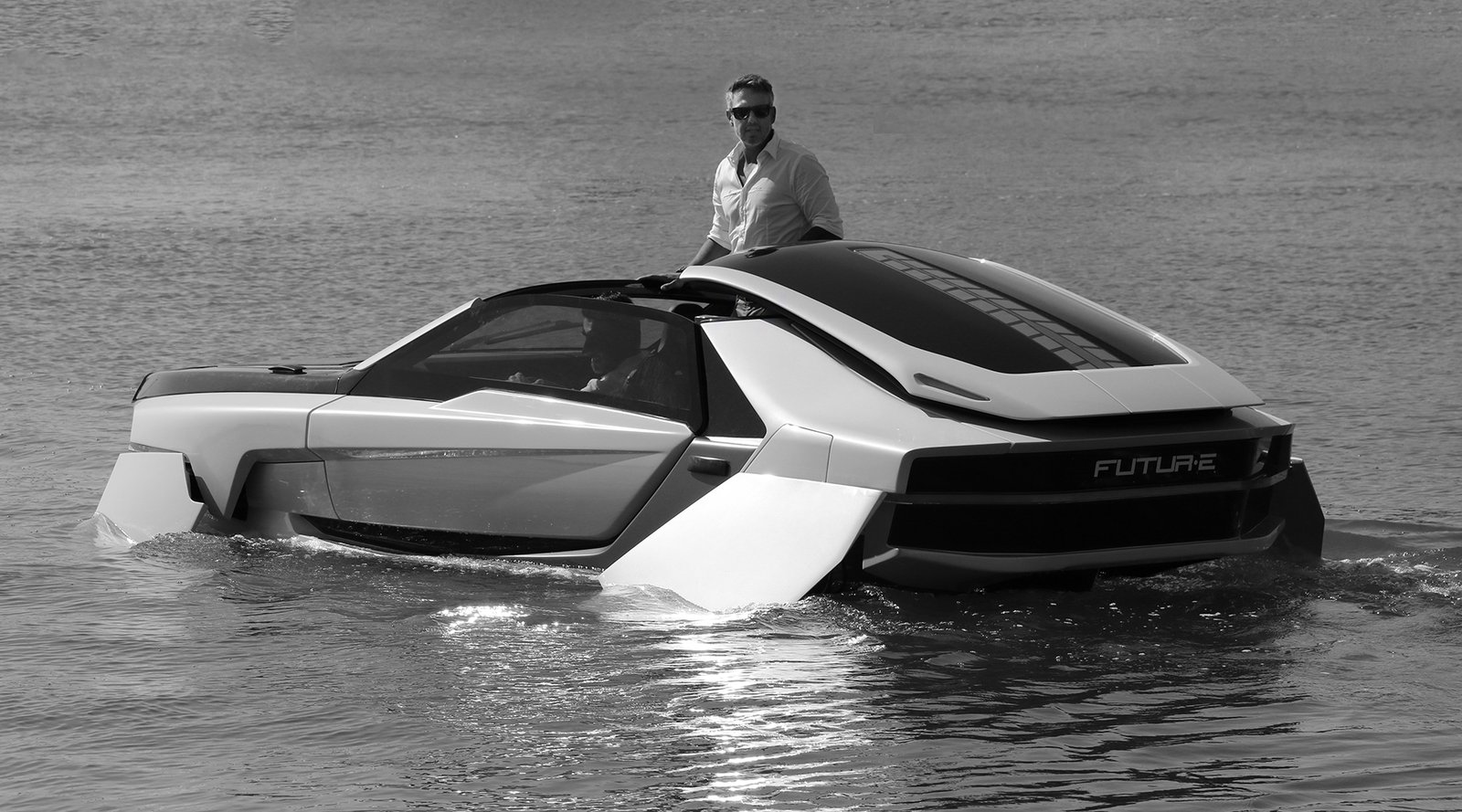
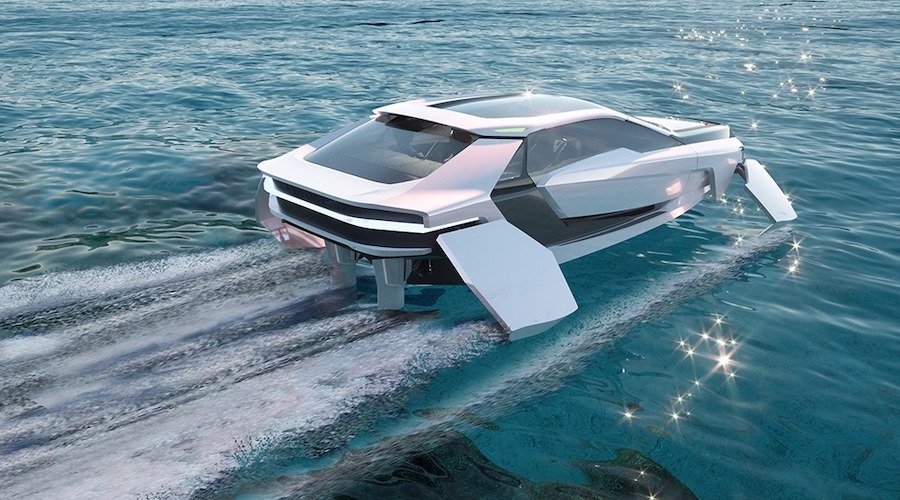
The first reaction to the FUTUR-E is always the same: it looks like a sports car that fell into the water and decided to stay. Scissor doors, stretched headlights, a wraparound windscreen and a rear end that would sit comfortably in any motor show.
The styling gets attention, and that is exactly what it is there for. But anyone working in the marine industry should be looking at something else: what sits under that bodywork, and what it says about where small boats are heading.
What the FUTUR-E is
It is an Italian project, born at the Centrostile Design studio, led by Davide Cipriani, in Mordano, near Bologna, in northern Italy. The company presents itself as Futur-E Foiling and showed the boat publicly for the first time at the Cannes Yachting Festival.
The dimensions surprise anyone who has only seen photographs: 5.20 metres long by 2 metres of beam. It is a small boat, the size of a lake runabout. It weighs 1,580 kg empty and around 2,000 kg loaded.
The accommodation follows automotive logic: a central helm seat, with room for two more passengers on a rear bench.
The detail that matters: four foils that think for themselves
Here is the technical part that justifies the story.
The boat does not use a fixed pair of foils, as most marine flight projects do. It has four independent foils, each driven by electro-hydraulic actuators, under the command of a control unit with a gyroscope.
The reference stated by the designers is Formula 1 car suspension: just as each wheel works on its own to keep the car planted on the track, each foil works on its own to keep the hull stable in the air.
Take-off happens in three stages:
| Speed | What happens |
|---|---|
| 8 knots | Foil-assisted mode begins, the foils start carrying part of the weight |
| 16 knots | Full foiling, the hull leaves the water entirely |
| Over 30 knots | Announced top speed |
In sea trials the prototype reached 32 knots, still using a conventional outboard, a 115 hp Mercury Verado, while the electric version was being developed. The project foresees two propulsion configurations: outboard, or inboard with a surface-piercing propeller.
Zero emissions, zero noise, zero wake
That is the company's central argument, and it is the point that deserves the Brazilian industry's attention.
A boat flying on foils produces no significant wake. With no hull in the water, no wave is generated. That stops being a technical curiosity and becomes a practical matter when you consider:
- Navigation on lagoons, lakes and rivers with banks vulnerable to erosion
- Environmental protection areas where wake is grounds for restriction
- Marinas and urban canals with hard speed limits imposed because of wash
- Anchorages where wake disturbs other boats
Add the electric motor, which deals with noise and local emissions, and the result is a craft able to operate in places where a conventional powerboat is turned away. Not because it is slower, but because it leaves no trace.
Construction follows the same logic: carbon fibre produced from 100% recycled fibre, with structural foam reinforcements that are also recycled.
The price, and why it is not the point
The announced figure was one million euros, before tax, for a five-metre boat.
It is easy to stop there and file the project under billionaire's toy. That would be a misreading, and the industry has made this mistake before.
Every technological leap in boating started expensive and at the top. It happened with GPS, with the autopilot, with fibreglass hulls, with joystick docking and with gyroscopic stabilisation. What is standard equipment on a 30-footer today was once a superyacht extravagance.
The FUTUR-E will not sell in volume, and that is not its job. Its job is to prove the package works: active foils under electronic control, a light hull in recycled composite and electric propulsion, all at once, in a small boat.
What it means for Brazil
Three practical readings for anyone who builds, sells or operates boats here.
First: foiling is no longer a sailing subject. For a long time, flying above the water belonged to offshore racing and the America's Cup. Now it is entering the leisure powerboat, and with an active system, not a passive one. Anyone designing hulls needs to keep up.
Second: efficiency is the electric argument, not batteries. The great limitation of the electric boat is range. Foils cut drag dramatically, because they lift the hull out of the water. Less drag means less energy for the same speed, which means more range from the same battery. Foiling and electric propulsion are not two trends that happened to meet, one solves the other's problem.
Third: recycled material has left the brochure. Recycled carbon fibre and recycled structural foam in a high-performance boat show that the environmental agenda has stopped being a sticker on the topsides and become a design specification. Brazilian yards aiming to export will meet that requirement on the other side.
A mirror for Brazilian design
One last comment, more provocation than criticism.
The FUTUR-E came out of an automotive design studio that decided to go to sea. It did not come from a boatyard. It came from people used to drawing cars, who looked at a boat and asked why it is still built that way.
Brazil has one of the largest marine industries in the Southern Hemisphere and an established automotive industry. The two almost never talk to each other. That may be the cheapest lesson this Italian project is handing out for free.
Specifications
| FUTUR-E | |
|---|---|
| Design | Centrostile Design, Davide Cipriani |
| Origin | Mordano, Bologna area, Italy |
| Length | 5.20 m |
| Beam | 2.00 m |
| Light weight | 1,580 kg |
| Loaded weight | 2,000 kg |
| Foils | 4 independent, electro-hydraulic actuators and gyroscope control unit |
| Foil-assisted mode | 8 knots |
| Full foiling | 16 knots |
| Top speed | over 30 knots, 32 knots recorded in trials |
| Construction | 100% recycled carbon fibre, recycled structural foam |
| Propulsion | electric, outboard or inboard with surface-piercing propeller |
| Announced price | one million euros, before tax |
By: Redação Mundo Mar
Photo: Imagem: divulgação Futur-E Foiling