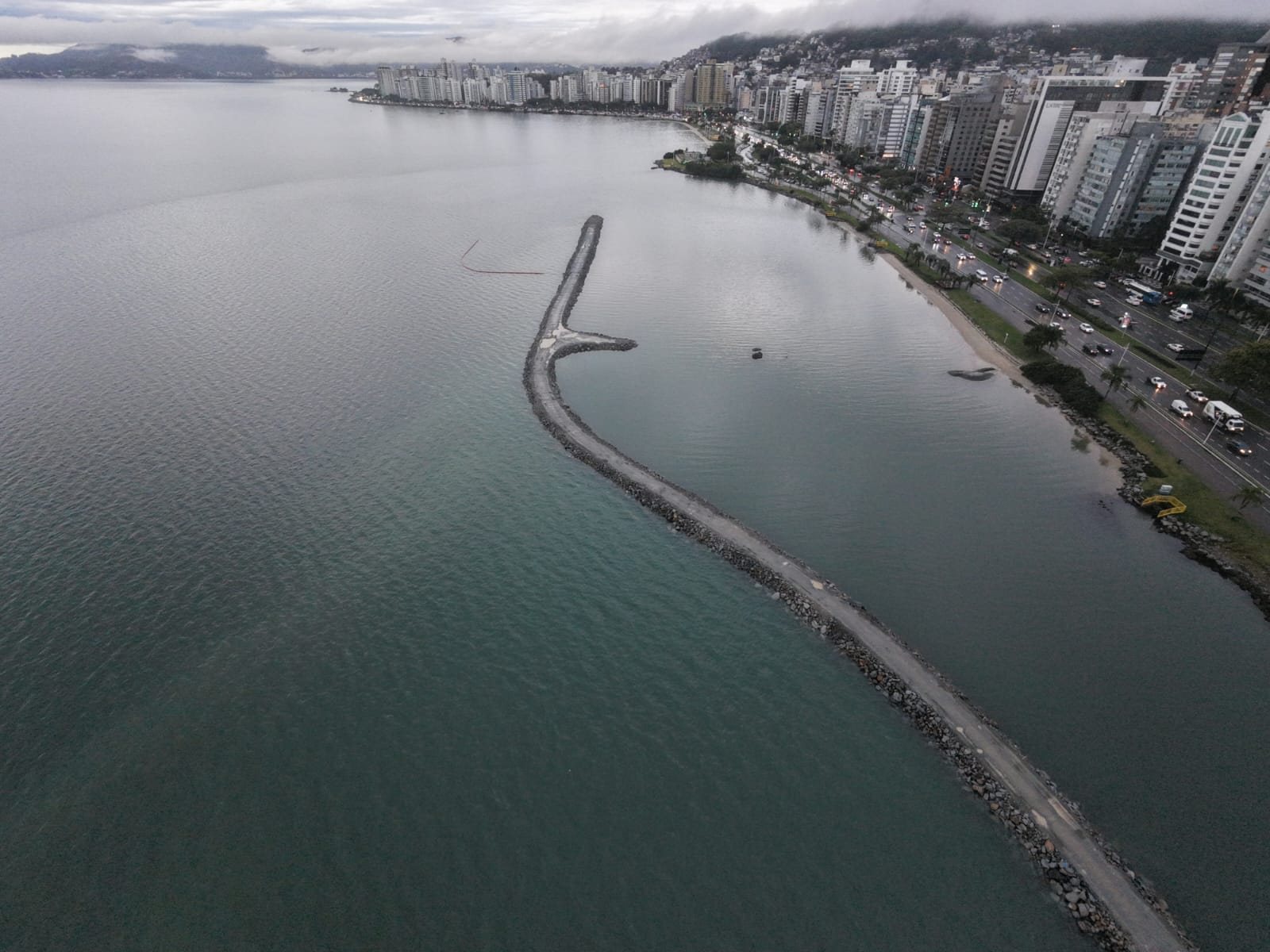
Anyone driving along Avenida Beira-Mar Norte today sees rocks. A tongue of riprap pushing out into the bay, truck after truck, and the scene looks like just another big construction site in a capital that has seen plenty.
It is not. What is being built there is the foundation of a piece of city that does not yet exist, and of an economic market that Florianópolis has never had at the scale it is about to.
Inside the project
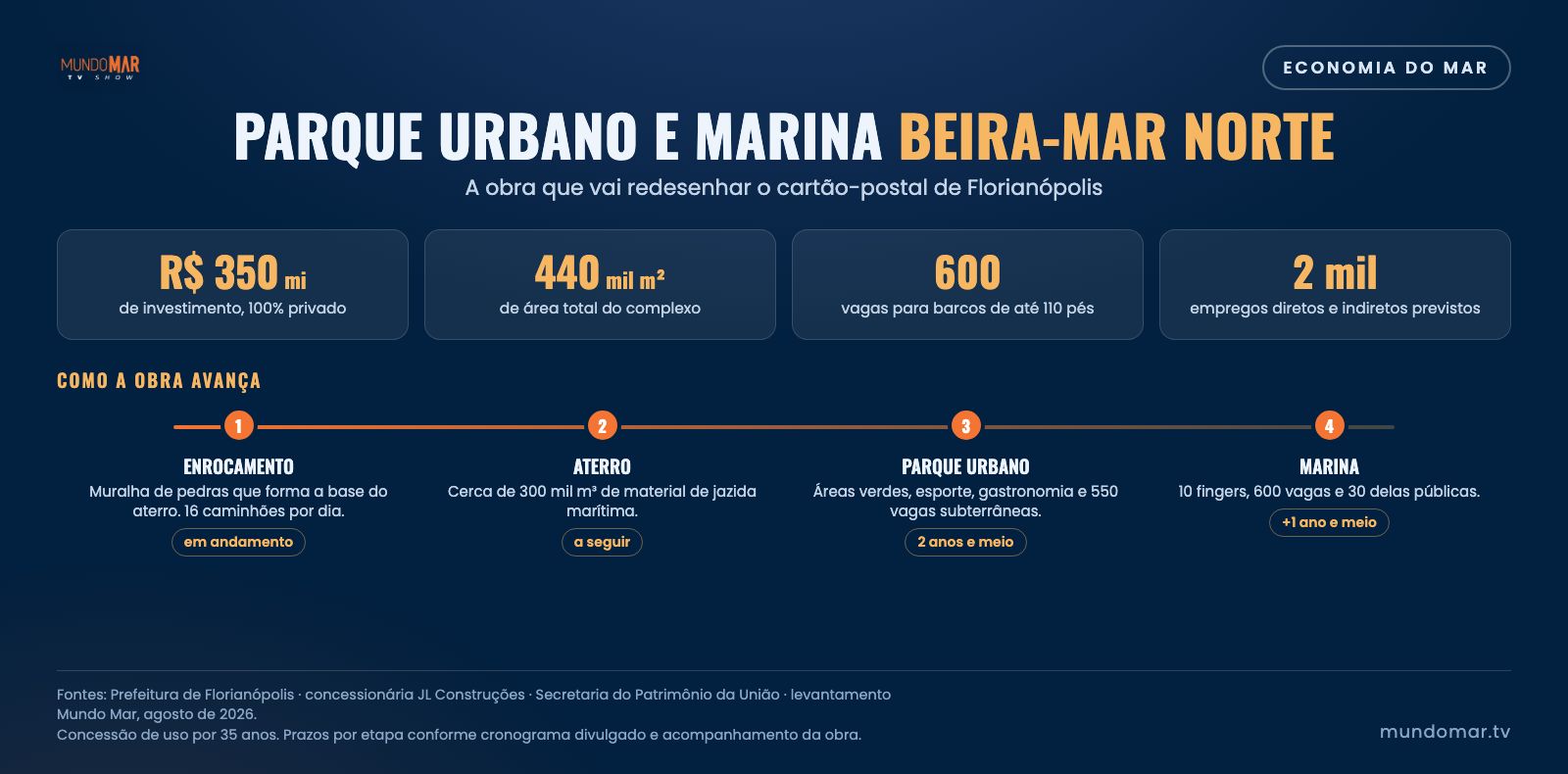
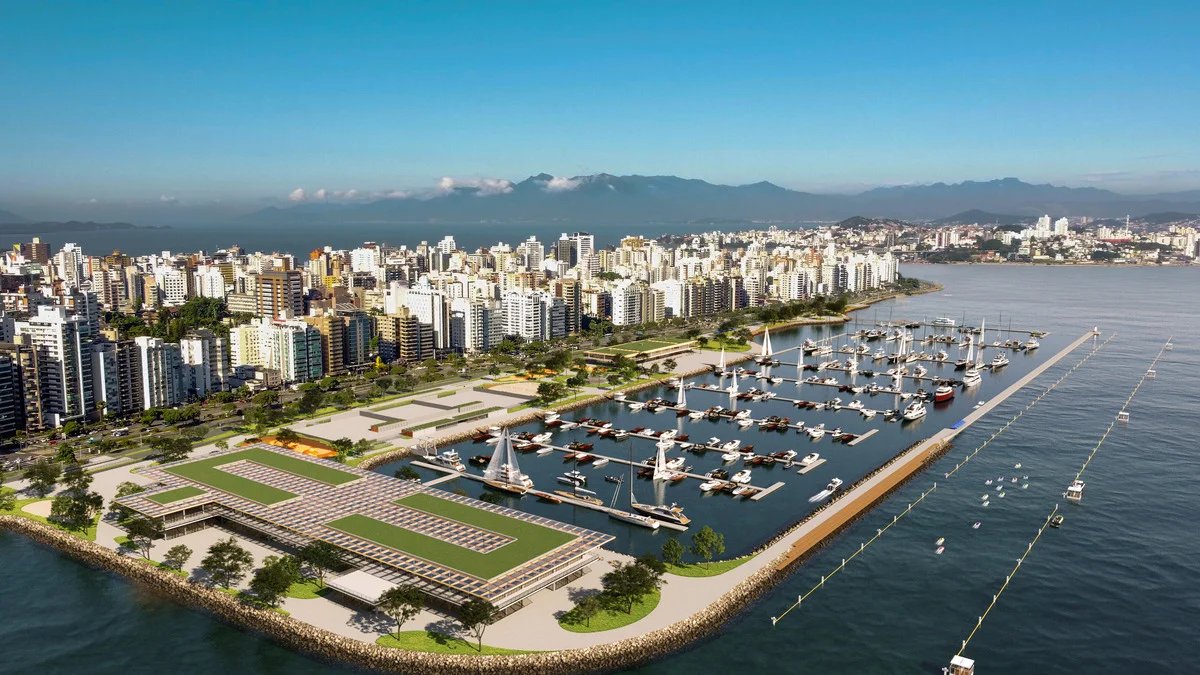
The Beira-Mar Norte Urban Park and Marina is a R$ 350 million development, financed 100% with private money. Construction went to JL Construções, from Cascavel, in Paraná, which won the tender and holds a 35-year use concession.
The complex covers 440,000 square metres. Of that, roughly 140,000 square metres are public urban park, and the marina takes up the remaining 300,000 square metres.
Work began in March 2026 with a low-impact site, and the first front is the riprap, the stone wall that forms the base for everything that comes after. Around 16 truckloads of rock arrive per day by road. Once the riprap is closed, the landfill follows, with approximately 300,000 cubic metres of material dredged from a marine borrow area.
The breakwater is running ahead of schedule
Here is the figure that catches the eye of anyone following the site closely.
The schedule allowed up to 365 days for this front. The pace observed on site, however, points to a much faster finish: four to five months to close this stage.
That is not a detail. On waterfront works, riprap is the classic bottleneck, because it depends on rock logistics, weather windows and environmental licensing all moving together. When that front runs early, the whole downstream schedule gains room. It means the landfill starts sooner, and the park and marina enter the queue earlier than expected.
A new city, not a new boardwalk
It is tempting to read the project as a waterfront refurbishment. That would be reading it small.
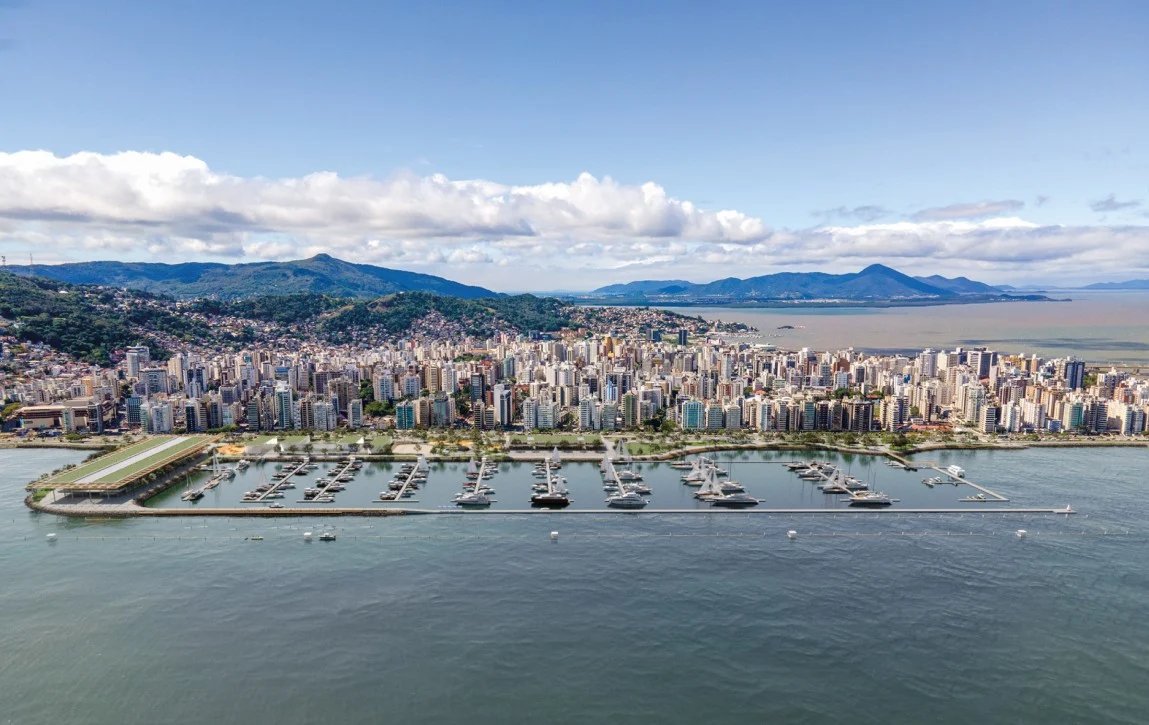
What is planned there is a complete piece of city, divided into sectors, with functions that do not exist today on that stretch:
- Sport and community: skate park, eight sand courts, outdoor gyms, playgrounds, a splash plaza and grandstands
- Food and drink: dining areas distributed across the three sectors
- Mobility: an extended cycle path, bus stops, planned BRT stations and 550 underground parking spaces
- Public service: restrooms, a pet area and a dedicated space for artisanal fishing
Add nearly 50,000 square metres of green areas and the result is an entire leisure district being born over the water, right next to the city centre.
A step change for a city that is already nautical
Now the point the nautical sector needs to grasp.
Florianópolis is not starting from zero. The capital has a traditional yacht club, marinas, dry storage, boatyards and service providers that have sustained the local nautical scene for decades, many of them ACATMAR members. That is the structure serving the Greater Florianópolis fleet today, and it remains the backbone of the sector.
What the city does not have is a marina of this size inside the urban core. That means 600 berths for vessels up to 110 feet, on 10 finger piers, concentrated at a single point right off Avenida Beira-Mar. It does not replace what already exists, it adds to it. And it adds at a different level, because it serves a class of vessel and a volume of traffic the capital cannot currently gather in one place.
Think about what a marina that size demands every single day: engine, electrical and marine electronics service, washing and polishing, hull-cleaning dives, upholstery and canvas work, provisioning, fuel, clearance paperwork, insurance, yacht brokerage, sailing school, charter and day trips.
It is exactly the same supply-chain logic we have described before: a boat does not create one job, it creates a network. The difference here is that the demand will be concentrated within a few blocks, in the heart of the state capital. And much of it lands with companies already operating in the region, which turns private investment into revenue for those already established.
Qualified nautical tourism, in practice
The phrase "nautical tourism" gets used loosely. It is worth spelling out what it means when a real marina exists.
When there is no berth available, the visiting sailor moves on. A foreign yacht coming down the Brazilian coast needs somewhere to moor safely, with water, power, fuel, clearance and technical service. If no berth is free for the period it wants to stay, it does not stop, or stops briefly, and spends little.
With more berths available, it stays. And when it stays, it consumes hotels, restaurants, groceries, workshops, taxis and tours. This is the kind of visitor who spends more per day and stays longer, because a boat in for service keeps the crew ashore.
Florianópolis has an obvious geographic advantage: it sits halfway along the route between southeastern Brazil, Uruguay and Argentina. What was missing was the capacity to receive that flow in volume. That is what is being built.
The jobs: how many and what kind
The official estimate is roughly 2,000 direct and indirect jobs. But the number alone hides what matters: the type of role that appears, and when.
During construction, the profile is heavy civil works: machine operators, truck drivers, surveying, technical diving, earthworks, rebar, concrete, civil engineering, environmental staff and workplace safety.
In marina operations, the profile changes completely, and this is where the nautical sector comes in:
- Dockhands and pier operators
- Outboard and inboard engine mechanics
- Marine electrical and electronics technicians
- Lamination and hull repair
- Upholstery and canvas
- Maintenance diving
- Washing, polishing and antifouling
- Marina management, sales and front desk
In the park and its surroundings comes the third group: food service, cleaning, landscaping, building maintenance, security, sports monitors and parking operations.
Note the sensitive point. The second group, marine operations, is precisely where Brazil already faces a shortage of qualified labour. Outboard mechanics, marine electricians and laminators are already scarce today, with current capacity. A 600-berth marina coming online increases pressure on a bottleneck that already exists.
In other words: the project creates opportunity and creates a problem at the same time. The opportunity belongs to whoever gets trained over the next four years. The problem belongs to anyone who thinks this can be solved the week before the opening.
What the sector should be doing now
Four years sounds like a lot of time. It is not, when the task is training technical professionals.
If the marina opens with 600 berths and there are not enough marine mechanics in the city, service will be expensive, slow and imported from other markets. If training is ready, the money stays in Florianópolis.
That is why ACATMAR has kept pushing the qualification agenda, with training programmes and the partnership with IFSC to set up the Sea School. The Beira-Mar Norte project has turned that debate, once abstract, into something with a date on it.
A postcard that becomes an economy
Florianópolis is going to gain a new view, and that is what will generate photographs and arguments over the coming years.
But what really changes the city is not the scenery. It is the fact that, for the first time, the state capital will have the infrastructure to receive, store, service and move hundreds of vessels in its urban core, with a public park wrapped around it.
This is not a waterfront project. It is the installation of a new economic chain in a city that already has everything needed to operate it, and that until now watched that economy sail past on its way to other ports.
The breakwater pushing into the bay is only the first stone, literally. What comes next is bigger.
Project fact sheet
| Beira-Mar Norte Urban Park and Marina | |
|---|---|
| Investment | R$ 350 million, 100% private |
| Concessionaire | JL Construções (Cascavel, PR) |
| Use concession | 35 years |
| Total area | 440,000 m² |
| Public urban park | around 140,000 m² |
| Marina | 300,000 m² |
| Berths | 600, for vessels up to 110 feet, on 10 finger piers |
| Public berths | 30, for institutions and artisanal fishing |
| Parking | 550 underground spaces |
| Jobs forecast | around 2,000, direct and indirect |
| Construction start | March 2026 |
Sources
Florianópolis City Hall, concessionaire JL Construções, the Federal Heritage Office, the project's environmental licensing and on-site monitoring by the Mundo Mar team. Nautical labour data according to surveys by ACATMAR, the Brazilian Nautical Association.
By: Redação Mundo Mar
Photo: Foto: João Calmon